Buying a Used Toyota Noah from Japan: What to Check Before It Lands in Jamaica
The Toyota Noah is one of the most underrated family vehicles you can bring into the Caribbean. It is a Japanese-market compact MPV with sliding rear doors, up to eight seats, and a footprint small enough to thread through narrow streets and tight parking lots. Because it was built for Japan, a Japanese used Toyota Noah also arrives right-hand drive — which is exactly what Jamaica requires.
If you are shopping for a used Toyota Noah for sale, here is what actually matters before you send money.
Why the Noah Suits Caribbean Roads
Jamaica drives on the left, and so does Japan, so a JDM Noah comes right-hand drive from the factory. No conversion, no awkward steering geometry. Most English-speaking Caribbean islands with left-hand traffic — Barbados, Trinidad and Tobago, St Lucia, Antigua, Guyana — have the same requirement, so a Noah transfers across the region relatively easily.
The Noah is also narrow relative to a full-size SUV, and the sliding doors are genuinely useful when you are parked on a busy road with children. The 2.0-litre four-cylinder petrol engine belongs to a widely used Toyota family, which means most independent mechanics already know it.
Common Noah Trims
Second-generation Noahs (roughly 2007–2014) came in several grades. Exact equipment varies by build year and factory options, so always check the actual vehicle rather than the badge.
- X – the practical entry grade, focused on value rather than frills.
- X Limited – a step up from the base X, usually adding a modest package of convenience items and alloy wheels.
- G / G Limited – the comfort-oriented grades with more cabin equipment.
- S / S Limited – sportier styling and suspension tuning.
- Hybrid grades – later cars with different servicing and battery considerations.
Grade matters less than condition. A well-kept X with a full service history will outlive a neglected G every time.
A Real Example Currently in Stock
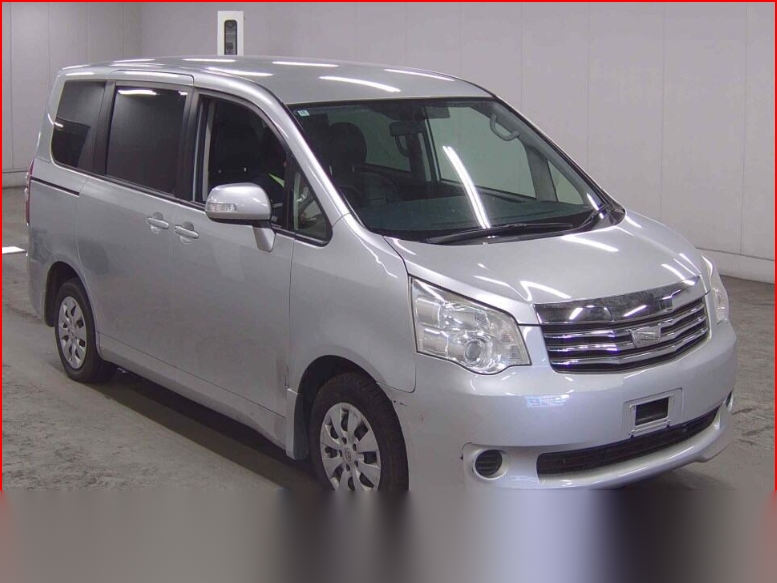
GULJI TRADERS has a 2012 Toyota Noah X Limited listed with these specifications:
- Engine: 2000cc petrol / gasoline
- Transmission: automatic
- Mileage: 148,990 km
- Drivetrain: 2 wheel drive
- Seats: 8
- Steering: right-hand drive
That mileage works out to roughly 11,500 km a year if the car was registered in 2012 — modest by Japanese standards, where many vehicles cover far more. It suggests a family car used for school runs and weekend trips rather than a hard-worked commercial vehicle.
The 2WD layout is front-wheel drive. That means fewer components to service and slightly better fuel economy than the 4WD version. If you regularly drive steep, slippery or unpaved roads, a 4WD Noah is worth hunting for; for most Kingston and coastal driving, 2WD is the sensible choice.
What to Check Before You Buy
Rust. Inspect the underside, sill panels, rear wheel arches and around the sliding door tracks. Coastal and salt-air cars rust faster, and bodywork is expensive to correct.
Sliding doors. Power sliding doors are a common failure point on ageing Noahs. Test both from the key fob, the inside button and the handle, and listen for grinding.
Transmission. Most 2.0-litre Noahs of this era use a CVT. Drive it from cold, look for hesitation or whining, and confirm the fluid has been changed on schedule.
Air conditioning. Check the front and rear blower. Caribbean heat punishes weak A/C, and rear evaporator repairs are not cheap.
Suspension and steering. Worn bushings, tie rods and shocks are common on rough roads. Listen for clunks over speed bumps.
Documentation. Ask for the auction sheet, export certificate and verified mileage. An honest grade with a clean history beats a shiny car with no paperwork.
Tyres and brakes. Budget for replacement if they are close to the end of their life.
Running Costs in Jamaica
A 2.0-litre automatic MPV of this size typically returns somewhere in the region of 9–13 km/L in mixed driving, depending on load, air conditioning use and traffic. A fully loaded eight-seater in stop-start Kingston traffic will sit at the lower end.
Routine servicing — engine oil, filters, plugs, brake pads — is affordable because the engine family is common. CVT fluid, coolant and brake fluid should be changed on schedule rather than on failure. Tyres are a common size and reasonably priced.
Remember the annual costs too: licensing, fitness, insurance and registration. And because body panels and interior trim are not stocked locally, drive defensively — cosmetic parts usually have to be imported.
How Toyota Noah Import from Japan to Jamaica Works
The process is straightforward if you work with a reputable exporter:
- Select and verify — get photos, a condition report and the auction sheet.
- Pay and ship — usually RoRo or container from a Japanese port such as Nagoya or Yokohama.
- Collect documents — export certificate, bill of lading, commercial invoice and marine insurance.
- Clear customs — duty is generally assessed on CIF value (cost, insurance, freight), plus GCT, environmental levy and other charges, along with broker fees.
- Comply and register — fitness inspection, registration and plates.
One caution: vehicle age limits, licensing requirements and duty structures are set by the Jamaican authorities and have been revised over the years. Confirm the current rules with Jamaica Customs and the relevant trade authority before paying a deposit. Other Caribbean islands set their own rules too, so verify locally.
The Bottom Line
A used Toyota Noah is a sensible, spacious and mechanically familiar choice for Jamaican families. Focus on rust, the sliding doors, the CVT and paperwork — not just the grade badge or the odometer. Get the condition report first, and the import will be far less stressful.
See it in stock: 2012 Toyota Noah X Limited — live price, full photos and auction sheet. Browse all Toyota cars.