Buying a Used Toyota Hiace from Japan: What to Check Before It Reaches Jamaica
Few vans have earned Caribbean trust the way the Toyota Hiace has. It hauls goods, runs routes, carries families and rarely complains. It is also one of the most common Japanese used imports in the region, which means buyers get plenty of choice — and plenty of chances to buy badly. If you are shopping for a used Toyota Hiace for sale, here is what actually matters.
Why the Hiace Works So Well Here
Toyota has built the Hiace since 1967, and the versions you see in Jamaica and across the Caribbean are mostly the H200 generation (2004 onwards) and, increasingly, the newer H300. The H200 moved to a semi-bonnet layout, putting the engine ahead of the cab — quieter, safer and easier to service than the old cab-over vans. Parts are widely stocked, most mechanics have worked on one, and 300,000 km is realistic with regular servicing.
Jamaica drives on the left, so a Japanese right-hand-drive Hiace is a natural fit. No conversion, no awkward reach for the gear lever.
Common Hiace Trims
DX / DX Package – the working trim. Vinyl floors, steel wheels, basic audio, often a 3-seat or 5-seat layout. Built to be loaded, not to impress.
GL and Super GL – mid and higher specs with better trim, power windows and more comfortable seating. Often 5–6 seats, sometimes 10–14 in passenger layouts.
Grand Cabin – long-wheelbase, more room for passengers and luggage.
Commuter – the 14-plus-seat bus variant. Useful, but licensing and insurance rules differ across the islands, so check before you buy.
Regius Ace – the Japanese domestic market name for the same van. A Regius Ace is a Hiace; don't let the badge confuse you.
Engines matter too. Petrol Hiace vans typically use the 1TR-FE 2.0L or 2TR-FE 2.7L, both chain-driven and simple. Diesel versions use the 2KD-FTV 2.5L or 1KD-FTV 3.0L, which give more torque and better economy under load but demand careful injector and pump maintenance.
A Real Spec Sheet
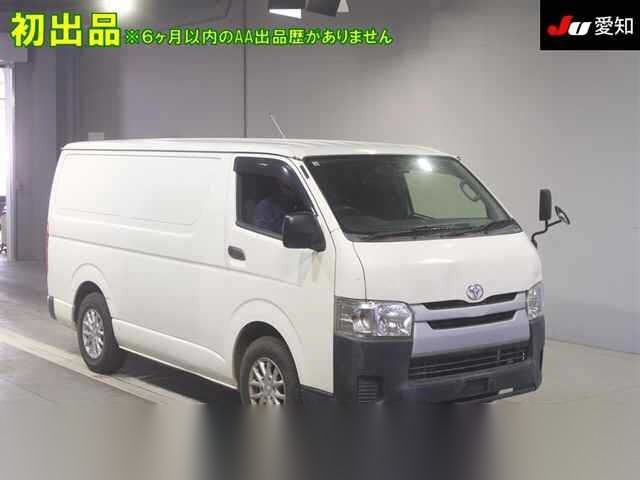
One example currently in GULJI TRADERS stock illustrates the pattern clearly: a 2017 Toyota Hiace Van DX Package, 2,000 cc petrol, automatic transmission, 87,579 km, 3 seats, right-hand steering.
Read that carefully. Three seats means a driver plus a two-person bench — a cargo-focused layout, not a people carrier. The 2.0L petrol engine is the simplest option in the range: no diesel injectors to rebuild, cheaper servicing and easy fuelling anywhere in the Caribbean. An automatic makes it a comfortable daily driver, and at 87,579 km the van is barely past its first act.
Be realistic about duty, though. A 2.0L petrol automatic is a light-load workhorse. If you plan to tow or run fully loaded up steep hills all day, a diesel may suit you better.
What to Check Before You Buy
- Rust, rust, rust. Inspect the rear wheel arches, the sliding door track, the windscreen frame, the floor pan and the chassis rails. Coastal and cold-region vehicles suffer most. A torch and a magnet help.
- Auction sheet and mileage. Japanese auction sheets grade condition and flag damage. Compare recorded mileage against the odometer.
- Service history. Oil changes every 5,000–10,000 km. Look for automatic transmission fluid changes in particular.
- Cooling system. Caribbean heat is hard on radiators, hoses and water pumps. Check for coolant stains.
- Air conditioning. Test it thoroughly — it is not a cheap repair.
- Suspension and brakes. Worn bushes and warped discs are common on loaded vans.
- Electrics. Windows, locks, wipers, reverse camera and any aftermarket wiring.
Running Costs
Budget for fuel, insurance, licensing and annual fitness testing. A 2.0L petrol automatic Hiace typically returns roughly 8–11 km/L in mixed driving, less when loaded, so fuel is your largest recurring cost. Servicing is inexpensive thanks to parts availability, but tyres and brakes add up if the van works daily. A diesel will burn less fuel but costs more to repair when injectors or pumps fail.
Importing from Japan to Jamaica and the Caribbean
The usual route is straightforward:
- Select the vehicle and review its auction sheet and inspection report.
- The exporter deregisters it in Japan and issues an export certificate.
- Ship it — RoRo is cheaper, container is safer for the bodywork.
- Receive the bill of lading and clear it through a licensed customs broker.
- Pay duty, GCT and other levies based on the CIF value and engine size, then licence and test it locally.
Jamaica applies age limits and other rules to used imports, so confirm current requirements with the Jamaica Customs Agency or the Trade Board before you commit. Allow roughly four to ten weeks door to door.
The Bottom Line
A Japanese used Toyota Hiace is one of the safest used-vehicle bets in the Caribbean — if you inspect properly, choose the right trim for your job and price the landed cost honestly. For a Toyota Hiace import from Japan, the paperwork matters as much as the van.
See it in stock: 2017 Toyota Hiace Van Dx Pacage — live price, full photos and auction sheet. Browse all Toyota cars.