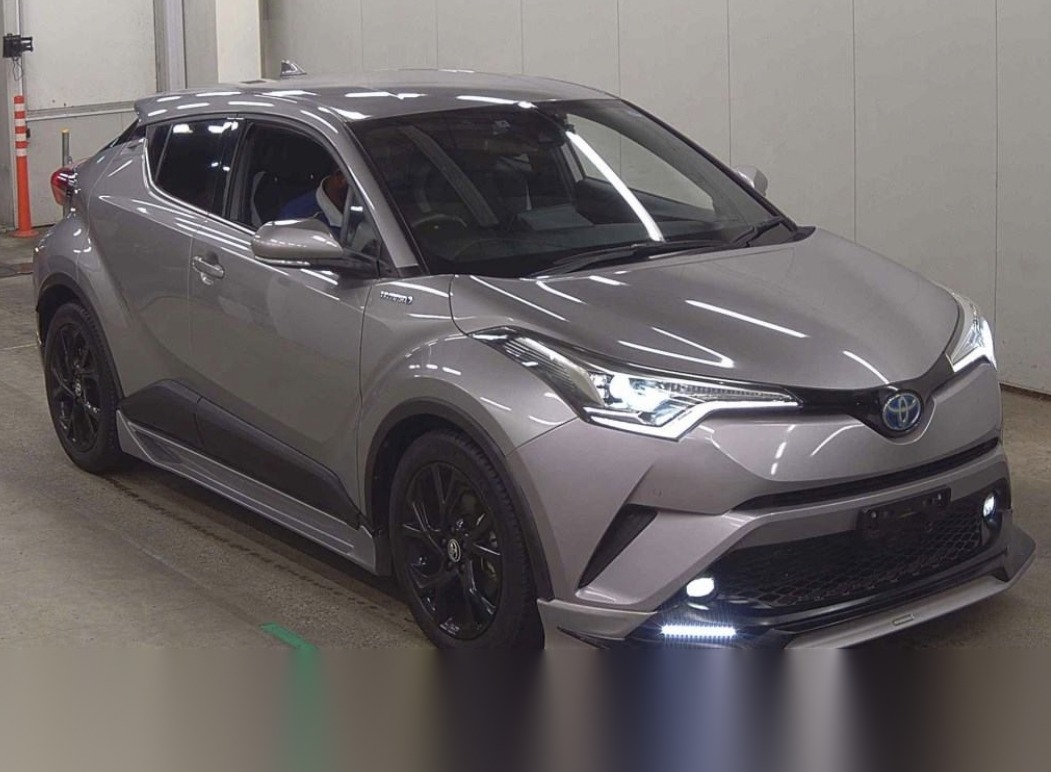
Thinking about a used Toyota C-HR for sale from Japan? The C-HR has been one of the most searched compact crossovers in the Caribbean since it launched in 2016, and the Japanese-market hybrid version is a genuinely smart buy for the region. Japanese cars are right-hand drive — exactly what Jamaica, Barbados, Trinidad and most of the Caribbean require — and the C-HR Hybrid shares its drivetrain with the Prius, one of the most proven petrol-electric setups ever built.
Why the hybrid C-HR suits Caribbean roads
The C-HR Hybrid pairs a 1.8-litre Atkinson-cycle petrol engine with an electric motor and an e-CVT automatic. There is no clutch, no turbo and no traditional torque converter, so there is very little to wear out in stop-start traffic. That matters in Kingston, Port of Spain or Bridgetown, where running on the electric motor and recapturing braking energy delivers the biggest savings. Expect roughly 5–6 L/100 km (about 17–20 km/L) in mixed real-world driving; official Japanese cycle figures are more optimistic.
What to check on a used Japanese C-HR
- Hybrid battery health. Ask for a diagnostic read showing battery block voltages and any stored hybrid fault codes. A tired battery is the single biggest potential expense.
- Mileage evidence. Low kilometres are great, but verify them against the auction sheet, the Japanese export certificate and physical wear — pedal rubbers, seat bolsters, steering wheel and door sill.
- Rust and underbody. Japan salts some roads in winter and ships from coastal ports. Check subframes, brake lines, strut towers, the boot floor and the rear hatch seam.
- Accident repair. Look for uneven panel gaps, inconsistent paint depth readings and missing VIN stickers on panels.
- Infotainment. Many JDM head units are Japanese-language and the FM band runs 76–90 MHz, so budget for a band expander or an aftermarket unit.
- Air conditioning. Non-negotiable in the tropics — run it on maximum and feel for a genuinely cold vent.
- Keys. Confirm two smart keys are supplied; replacements are costly and must be programmed.
- Tyres, brakes and the 12V battery. Regen braking means pads often last a long time, but check for seized calipers after long storage.
Common Japanese trims and grades
Japanese C-HR grades you will see on auction sheets include S, G and G-T, along with periodic special editions that bundle blacked-out styling and extra kit. Higher grades typically add LED headlights, larger alloys, dual-zone climate control and Toyota Safety Sense (pre-collision braking, lane departure alert, radar cruise and automatic high beam). Across hybrid grades the 1.8-litre hybrid drivetrain is essentially the same, so trim mostly buys equipment and appearance rather than performance.
Running costs to budget for
- Fuel: the biggest saving, especially in city traffic.
- Servicing: oil and filter roughly every 10,000 km or annually, plus brake fluid, filters and hybrid coolant at the manufacturer's intervals.
- Licensing and fitness: in Jamaica these are annual costs, and insurance depends on your insurer and use.
- Consumables: tyres, a 12V battery every few years, and eventually the hybrid traction battery — although these commonly last well over a decade.
- Parts: because the drivetrain is shared with the Prius, most mechanical parts are widely available across the Caribbean.
How importing from Japan to Jamaica and the Caribbean works
A Toyota C-HR import from Japan usually follows the same path:
- Source the car through a reputable exporter or auction house, and insist on the auction sheet and inspection report.
- Export paperwork in Japan — the exporter handles deregistration and issues the export certificate (with English translation), invoice and packing list.
- Shipping from Yokohama, Nagoya or Kobe by RoRo or container, arriving in Kingston or another regional port several weeks later.
- Customs clearance. In Jamaica, duties and taxes are assessed by Jamaica Customs on the CIF value (cost, insurance and freight) and typically stack import duty, Special Consumption Tax (which varies with engine size and vehicle age), GCT, an environmental levy and other charges. Confirm current rates, the age limit on used imports and any import licensing requirement with the Trade Board and Jamaica Customs before you commit.
- Compliance and registration. After clearance the car is inspected by the Island Traffic Authority for a certificate of fitness, then licensed and registered.
Other Caribbean territories run their own age limits, duty structures and inspection regimes, and several offer concessions for hybrids. A licensed customs broker is almost always worth the fee, and an independent pre-shipment inspection in Japan is cheap insurance.
A real example in stock
GULJI TRADERS has a 2019 Toyota C-HR Hybrid currently in stock, listed as a Hybrid Push Start Hybrid G Mode Neo: 1,800 cc petrol/gasoline hybrid, automatic transmission, 13,107 km, five seats and right-hand steering. For a 2019 car that is low mileage, and the right-hand-drive layout suits Jamaica's roads. Contact us for availability, pricing and shipping details.
The bottom line
A Japanese used Toyota C-HR hybrid is a sensible Caribbean buy: proven Prius-based mechanicals, strong fuel economy in traffic and right-hand drive from the factory. Check the battery, verify the mileage, budget for duties and licensing, and a well-chosen C-HR will serve you for years. If you are looking for a Toyota C-HR Jamaica buyers can actually inspect, GULJI TRADERS can help you find and import one.
See it in stock: 2019 Toyota C-hr Hybrid Push Start Hybrid G Mode Neo — live price, full photos and auction sheet. Browse all Toyota cars.